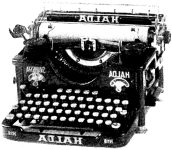
What is writing for? What matters, who wrote some text, or who reads it? One idea is that text — I’ll call it “literature” here — only matters, and only really exists as a significant entity at all when someone reads it. This is a key idea from “reader-response criticism,” a branch of literary theory. In this view, the author writes a document, but if nobody reads it, the text doesn’t really matter. Moreover, the meaning the reader finds in the text is more significant than the meaning the author may have intended. The author may not have had any intention at all, but the reader’s interpretation is important, regardless. Maybe the author used the cut-up technique, where you slice up a printed page and rearrange everything. Or maybe there is no author at all in the usual sense; it’s a series of gears and cams and pulleys that move words into different combinations. A reader can still find meaning in it, and according to reader-response theory, that meaning is important.
The point here is that maybe the source of a document does not matter if you find it meaningful when you read it. Let’s say you read something and it speaks to you, maybe presenting a new idea you hadn’t considered. That consideration of an idea is yours; it exists in your mind. It arose out of a combination of you and the text, regardless of what the author had in mind. In the case of reorganized or randomized text from something like the cut-up technique, and in the case of mechanically-assembled text, there might not have been an author’s mind at all. Nevertheless, you as the reader might create meaning when encountering (reading) the text.
What if you received a small library of books to read, but each book had no information at all about the authors? Assume you read the books, or most of them, and found some of them very good. How might the lack of information about authors affect your reactions to and opinions about the books? Would you feel the same about these very good books as you do about books you think are very good and you know the authors’ names?
What about other things you might know about authors? Many people changed their opinions about the Harry Potter series (or at least reexamined them) when that author began publicly attacking the gay community. Another situation might be what you think you know about an author, but if you look more closely you might begin to wonder. Some people wonder whether William Shakespeare really authored his plays. But does the value you might see in a Shakespeare drama come from what you know (or don’t know) about Shakespeare himself?
What do you really know about most authors whose work you read? You know a name, but that might be a pen name. You might see a photo on a book jacket, but whether that’s authentic only the author and their acquaintances can tell. You might have read a brief bio in a review or on the back cover of a paperback, but while you could try to investigate its accuracy, that would be a pretty unusual thing to do.
And yet think about the word “authority.” It suggests trust, acceptance of the correctness of information, reliability. It comes from “author.” The Latin root is auctorem, a founder or leader. A master. I think we implicitly imbue authors with authority, and we rely on them. Even if it’s just trusting the the Agatha Christie novel we haven’t read will be as entertaining as the ones we have, we employ the image we construct of an “author” to make prejudgements. We want to see the new Spielberg movie. When is that Steven King novel being released?
But on the other hand, we have writers like Robert Ludlum. He passed away in 2001. Yet 30+ “Robert Ludlum novels” have been published since then. If you read The Bourne Sacrifice, The Bourne Shadow, The Bourne Escape, and others, you’re reading books written “under the Ludlum brand” by other authors.
Also think about Victor Appleton, Carolyn Keene, Franklin W. Dixon, and Laura Lee Hope. They were fantastically prolific and very long-lived authors of series of children’s novels published by the Stratemeyer Syndicate. Not one of them was a real person; they were all pseudonyms. Generations of young readers had collections of Tom Swift, The Hardy Boys, the Bobbsey Twins, Nancy Drew, and other series. The books were brands, and the authors’ names, as fanciful as the “Mrs. Fields” and “Aunt Jemima” of food products, were part of the brand.
Every young reader who enjoyed a mystery story starring the Hardy Boys or Nancy Drew knew the name of the author, but they knew nothing at all about the actual authors. And yet they still enjoyed the stories. The Stratemeyer Syndicate certainly sold enough copies to prove that.
All this brings me to the question of document generation by large language models. There’s a fair amount of controversy around the idea, and one camp holds that anything AI-generated text should be discounted because of the source. I’m not so sure. If you find meaning or inspiration or an idea in a piece of writing, that’s between you and the document. As the reader-response theorists argue, it doesn’t matter where the document came from.
