
If you have a reasonably detailed understanding of modern physics, you probably know about the Schrödinger equation. It’s as fundamental to quantum physics as Isaac Newton’s Second Law is to classical physics. Newton’s is easily expressed in English: The change of motion of an object is proportional to the force impressed; and is made in the direction of the straight line in which the force is impressed. It’s even simpler in math: F = ma, where F is the force applied (impressed) to an object, m is the mass of the object, and a is the acceleration (change of motion).
Quantum physics being what it is (complex and weird), the Schrödinger equation is not particularly easy to express in either English or math. This is it mathematically:
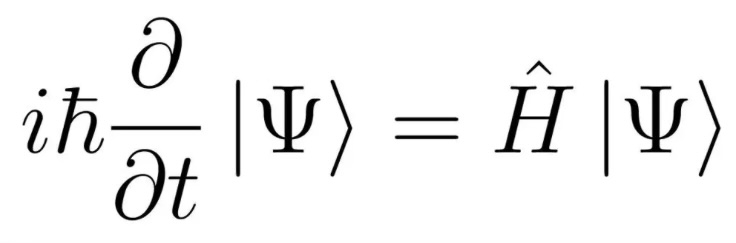
You can find a reasonably clear explanation here. In English, the equation is describing wave functions, which are the basic building blocks of the quantum universe, which is the universe we inhabit, but we don’t directly perceive anything at the quantum scale. In the equation, ψ (psi, a letter in the Greek alphabet) represents the wave function.
There’s one other symbol in the equation I want to point out: the t right after the lower ∂ character. By the way, the ∂ is not a Greek letter; it’s just a stylized letter d. It’s used in math to mean a “partial derivative,” which I’m not going to go into, but you can look up. The t stands for time. And that’s what this piece is all about, time. It’s inspired by this essay by Mike Brock, who knows a lot more about the area than I do.
There’s a problem with time: nobody knows what it is or where it comes from. In everyday life, we tend to think of time as something like the ongoing, consistent ticking of a clock. We have our own personal clocks, and I think it’s pretty common to assume that the universe itself has something like a clock, too. Or that “there is a clock” that applies to everything. After all, we can measure time, even to the extent that we can estimate when the universe began and predict things far in the future, like when the Andromeda galaxy will encounter our own Milky Way. But in physics, there’s a conundrum. In classical physics, we have general relativity, which says time is, well, relative. The faster you travel, relative to someone else, the slower time goes for you. This is not a feeling that time slows down; it actually, physically does slow down. This is a known, observed, proven phenomenon. Astronauts have carried extremely accurate clocks into orbit and back home again. When the traveling clock’s time is compared to an identical clock that never moved (relative to the traveling clock), the traveling clock shows a different amount of time has elapsed.
This is not in dispute. We know that time is not constant. But in quantum physics, time is constant. It’s a “background parameter,” and has a special status: it exists outside the quantum system. When some aspect of a quantum system is measured, that measurement happens at a specific instant. Measurements in quantum systems are of probabilities, and the probabilities observed at one instant differ from those observed at any other instant. The difference between the instants comes from somewhere outside the quantum system you’re observing. There’s no relativity involved; the elapsed time between instants does not vary if the quantum system is moving in relation to another quantum system. In quantum physics, then, time has to come from somewhere else. But where? It can’t be the universe described by classical physics, because in that universe we know time is relative, so the motion of a quantum system in relation to another one absolutely has to make a difference. Uh…right?
There’s another problem with time in physics: physical phenomena at the smallest scales can work in both directions of time. According to the physical laws, which have been tested and observed to an astonishing degree of precision, there’s no reason why time couldn’t “go backwards.” The basic process of the physical universe would just continue working as before. Except time doesn’t go backwards. Why not? Nobody knows.
These problems with time are deep within complex science, and yet they speak directly to our everyday experience. Or at least they can. Because we experience time. Our experience of time does not entirely agree with either general relativity or quantum mechanics. We don’t move at speeds that make a noticeable difference in the passage of time, and even if we did, we don’t measure time with that degree of precision; there’s no need for it in everyday life. The physical processes that could move in either direction through time are very tiny, below our ability to directly perceive them.
But everyone has experienced time passing more slowly sometimes, more quickly other times. You can easily find descriptions of such experiences in many accounts of artistic, artisinal, athletic, and spiritual activities. We assume that these experiences are subjective and have more to do with our bodies and minds. But being honest, those assumptions are just guesses. What if the way we experience time is not subjective, but a quality of the world we live in? What if it’s our assumption about time is the wrong guess?
If we come to an understanding that time is not the steady, monotonous “ticking” of some universal clock, but something entirely different, we might learn to regard it and live with it quite differently. I’m no scholar of Buddhism, but I’ve read a bit, and I think meditators in that tradition, even thousands of years ago, came to a different understanding of time. That time is not outside ourselves, and is not a universal “flow”. Our perception of time as “passing” can be altered, as we all know from the kinds of experiences I mentioned. I believe the mediation practices from Buddhism (or possibly from some types of Buddhism; I’m not well versed in it) can contribute to an ability to control our perception of time.
Remembering that while we have firm, repeatable experimental evidence of time appearing to play a role in physical phenomena, we’ve never found any compelling evidence suggesting what time is, or how it really works. But maybe an experiment at the University of Birmingham provides the first bit of that evidence. The experiment itself is complex and sounds like science fiction; a few atoms of some very rare substance (“rubidium,” which I never heard of before) were cooled to as near absolute zero as possible, and isolated from everything else by…well somehow. The atoms acted as a kind of mini-universe. Completely unaffected by things outside it, including any sort of process imposing time on the atoms. The experiment, led by Professor Giovanni Barontini, showed that time emerged from within the mini universe. It existed in a quantum state — a kind of timeless “now” — and time emerged from changes in that quantum state.
Quantum states are waves, and the waves interfere with each other, as waves do. As I understand it, it’s the wave interference that produces “superpositions,” which are the probabilities that suggest multiple possibilities, like an object existing in different places at the same time. Or a cat being both alive and dead at the same time (that would be Schrödinger’s cat, of course). While I don’t understand everything about the Birmingham experiment, or about quantum theory, I think the results suggest that the phrase “at the same time” is the crux of the matter.
The mini universe didn’t have any external source that provided time, and so the whole universe existed in a “now” that had no flow; no ticking of a clock. If a mini universe works that way, why wouldn’t our macro universe be subject to the same rules? At the same time isn’t some weird, hard to explain phenomenon that’s only revealed to advanced quantum physicists. It’s the way things really are. We can learn to perceive and experience our own universe in a more profound and authentic way. You do have the time, because you create it.
