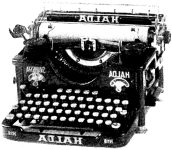
Writer has been my self-description for my whole adult life. Not the only one, but probably the one with the longest standing. I’ve had a daily writing practice for longer than I remember. As I’ve occasionally mentioned, a writing practice, at least for me, is not necessarily aimed at producing anything to be read, even by me. It’s often a way to understand something. Work out an approach to a problem. Think of things I missed before, or integrate new things I’ve learned with what I already knew, and shift my understanding to a different angle.
There are also times when I’m writing something that I do hope will be read. Sometimes by just one person, if I’m writing a personal letter. Sometimes by a very specific audience, if I’m writing about a product or service or lecture notes for a class. And sometimes by a vague idea of an audience, like readers of an online post or essay, or anybody who might be interested in a book I publish.
There are countless tools for writing. A fascinating aspect of writing tools is that any can be used for any sort of writing. This is not true of all tools; if you have a 12-millimeter wrench, it won’t help you paint your house. Or, for that matter, write a journal entry. But if you have any kind of working pen or pencil, and some paper or paper-substitute (is there any good substitute for paper?), you can do any kind of writing.
Nevertheless there are, for me, writing tools more useful for certain writing tasks. Pen and paper is a more flexible and adaptable system when I’m writing just for my own understanding and don’t expect anyone else to read any of it. I think of that kind of writing as “generative,” and my term predates “generative AI,” so I’m keeping it. Generative writing is often nonlinear. I attach side notes, draw arrows between points I want to connect, circle passages, and doodle aimlessly. A page or two of this writing might start out on one topic, in one direction, and veer off into something completely different in a way that would make little sense to anyone, even if they could read my handwriting (which I swear isn’t that bad, but still).
An important aspect of generative writing is that it’s usually one-and-done. I seldom revisit it, and nobody else sees it – often because it might exist on the back of an envelope or on a piece of scrap paper, and I don’t even keep those once I’m done. The thoughts I’ve worked out on paper are now in my mind, where I can call them up at will. Usually.
When I’m writing something I hope will be read, I revisit it, edit, revise, rewrite, add to it, and improve, sometimes over weeks or months. Sometimes this is because I’m documenting a product or service while it’s being developed, and more information keeps arriving. Sometimes it’s because I’m working on a story or essay and I reach a point where I decide to pause for a while. When I reread and amend, I’m using writing to communicate. This is symbolic writing.
Symbolic and generative writing nicely echoes symbolic versus generative AI. Symbolic AI is the previous generation, and is all about specifying relationships and logic. Generative AI is the current generation, and is all about using statistics for recombination. There are a few hybrid approaches that combine the AI approaches. These are “neurosymbolic” systems (I’ve even built one: Horatio). Horatio is a documentation search and retrieval system that offers a chat-style natural language interface with logic-based retrieval that never confabulates.
But what if there was an authoring tool that was a different type of hybrid, offering an environment suitable for generative and symbolic writing? I’m not sure it’s possible, but I do think it’s worth a try. Working title: Amanuensis.
