Along with many of my former colleagues, I find myself unexpectedly “standing in the middle of a transition where we cannot remain standing.” In our case today it’s due to a disembodied decision somewhere in an enormous organization. In the case of the author of that quotation, Rainer Maria Rilke, the transition belonged to Franz Xaver Kappus, a cadet in an Austrian military academy. Kappus was trying to decide whether to become a writer or a military officer. In the end he did both.
I had forgotten Letters to a Young Poet until just recently reminded of it. It’s a collection of letters by Rilke to Kappus. Kappus had discovered, from a teacher’s comment, that Rilke had attended the same school, and he wrote to the poet asking first for comments about his poetry. Rilke declined that request, telling Kappus Nobody can advise you and help you, nobody. There is only one way. Go into yourself.
I doubt very much that any of my colleagues are contemplating a choice between writing poetry or serving as a military officer. I certainly am not. But we are all now faced with difficult and serious choices, very much what Rilke addressed: they are difficult things with which we have been charged; almost everything serious is difficult, and everything is serious.
It was no more than a happy accident that reminded me of this book, which I read decades ago. I was in college at the time, and not immediately faced with any difficult decisions. Returning to the book today, I’m learning different things than I gleaned from it back then. But I’m still taken by the sensitivity and wisdom of Rilke’s advice. He reassures Kappus that The situation in which you now have to live is no more heavily laden with conventions, prejudices and mistakes than all the other situations…
There is a degree of sadness in being cast aside from one’s employment, just as there was for Kappus in a different time and place. But it is so important to be lonely and attentive when one is sad: because the apparently uneventful and stark moment at which our future sets foot in us is so much closer to life than that other noisy and fortuitous point of time at which it happens to us as if from outside.
One thing Rilke wrote the Kappus is something I do recall from my first reading, and I’d recommend it (and the whole book, really) to anyone in a period of transition, especially one that feels sad and perilous and uncertain: be glad and confident.
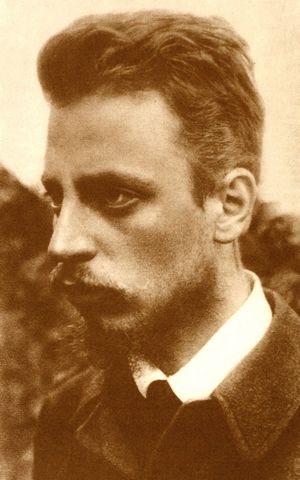
Rainer Maria Wilke in the era of his letters to Kappus. All quotations are from Letters to a Young Poet, published (by Kappus) in 1929, after Wilke had died.
